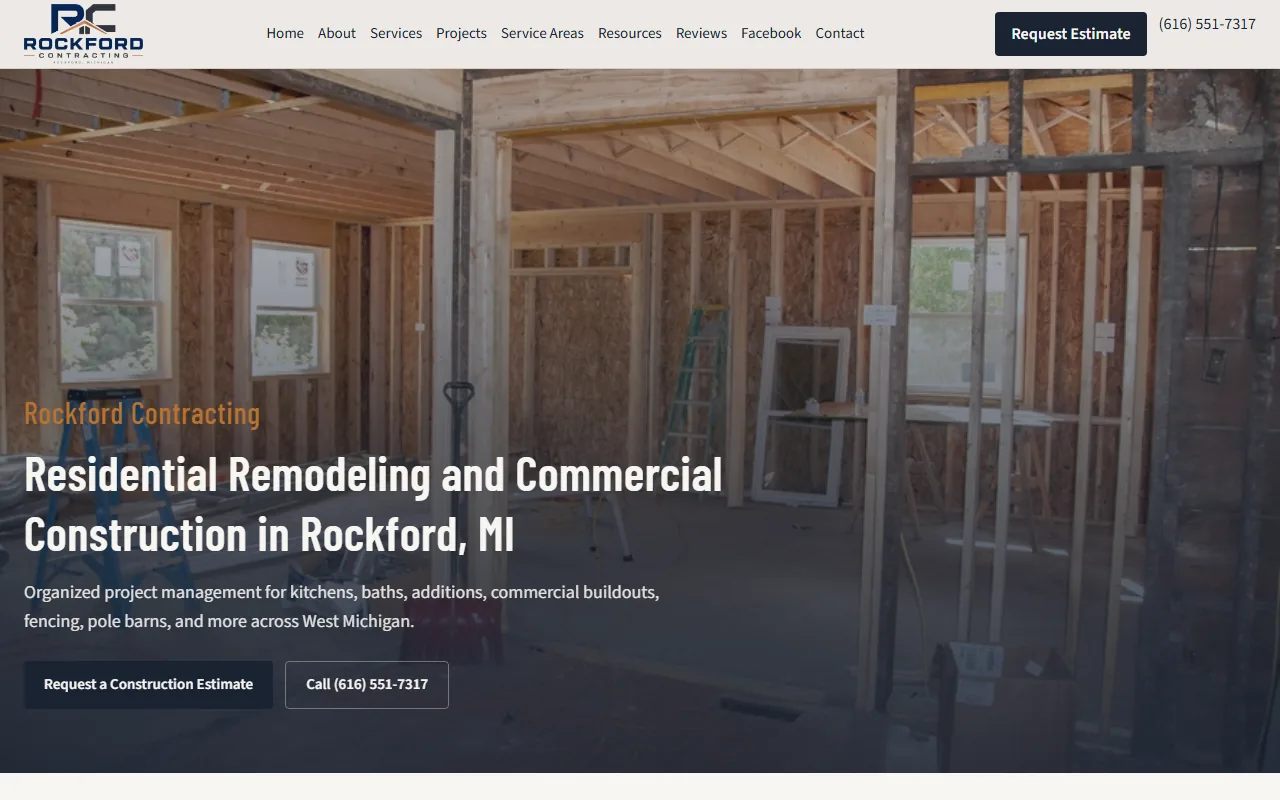
A contractor website costs what the work behind it costs: how many pages it needs, who writes them, where the photos come from, and what the site has to do beyond showing information, such as taking quote requests with photos or booking estimates. Our websites start at $5,000 for the build, and hosting is quoted separately for each project. Other routes cost less up front, like a monthly builder plan, or more, like an agency package that also runs your ads.
The price is only half the comparison. The other half is what you own when the work is done: the domain, the words and photos, and the accounts behind them. This guide covers both. For what a contractor site needs to do in the first place, start with our contractor websites page.
How much does it cost to build a construction website?
Most contractors end up choosing between three routes:
- A do-it-yourself builder plan. You pay monthly and build the pages yourself, or pay extra for the company to set them up.
- A one-time build from a freelancer or a firm. You pay for the build, then a smaller monthly amount for hosting and upkeep.
- A marketing package with the site bundled in. The website comes as part of a monthly contract for SEO, ads or leads.
Published prices vary widely, and few of them say what’s included. Two examples: B12’s contractor pricing page lists plans from free to $399 a month, with an optional $1,999 setup on its top two plans. Project Cost Estimator puts a general contractor site at $3,650 to $11,600 from a freelancer and $8,700 to $26,100 from an agency (updated July 2026), based on quotes and rate benchmarks it doesn’t list one by one. Treat both as examples of what you’ll see while shopping, not as an average. We checked both pages in November 2026, and prices like these change.
Our own number: websites start at $5,000 for the one-time build. Hosting and any other services are quoted per project, as separate lines. Our website cost page shows how that number moves for every kind of site we build.
What raises the price of a contractor site
Two contractor sites can look alike in a screenshot and be very different jobs. These are the things that move the number.
How many pages
Each service you want to be found for needs its own page. A painter with interior, exterior and cabinet pages has a smaller site than a remodeler with fifteen services and a page for each town they work in. Town pages only make sense where you have something true to say about the town, which our guide to service area pages for contractors explains. More pages means more writing, more photos and more testing.
Who writes the words
This is often the biggest hidden cost. A page that ranks and convinces people needs specifics: what the job includes, how long it takes, what affects the price, what the customer has to do. If you can write a few paragraphs per service, or talk them through on a call, the build moves faster. If the builder has to research your trade and write from scratch, that time is in the quote. It’s usually worth paying for, since thin pages rank poorly and read like a placeholder.
Photos
Your own job photos, taken on a phone, beat stock photos. The cost question is how many you have and how organized they are. A folder sorted by service with a few dozen good before-and-after shots is quick to use. Hunting through three years of camera rolls, asking homeowners for permission, or hiring a photographer for the crew and trucks all add time.
Quote forms and integrations
A basic contact form is cheap. A quote form with a photo upload, a ZIP code field and alerts that reach a phone by text and email takes more work and more testing. Connecting the form to job-management software, a CRM or a payment provider adds more, and the price depends on how well that other system’s connection is documented.
Booking
Letting customers book an estimate online means a calendar, rules for when you’re available, reminders, and sometimes a deposit. It saves phone tag, but it’s a feature with its own setup. Our page on booking websites covers what goes into one.
SEO setup
Every site should launch with clear page titles, a sitemap, structured data and a Google Business Profile that matches the site. That’s part of a good build. Ongoing SEO, such as new guides every month, is a separate monthly cost. Be wary of any price that comes with a promised ranking: no one controls Google’s results.
Replacing an old site
If you already have a site with pages that get traffic, the rebuild should keep those addresses working with redirects. A five-page site is quick to map. A site with years of blog posts takes longer.
Renting a site versus owning it
Many monthly plans work like a lease. You pay every month, the site lives in the company’s account, and what happens when you stop paying depends on the contract. Ask what you keep before you sign. If the plan doesn’t answer in writing, plan as if you’d be starting over.
Owning doesn’t mean the site runs for free. Almost every site, including the ones we build, sits on a hosting platform that charges monthly. The difference is whose name is on the accounts, and whether you keep the domain, the content and the right to hire someone else to look after it.
To compare options over time, put every one on the same three-year line:
three-year cost = up-front price + (monthly price x 36)As an example, B12’s Professional plan at $199 a month comes to $7,164 over 36 months, or $9,163 with the optional setup fee. Its pricing page doesn’t say what happens to the site if you cancel, so that’s a question to ask any provider, not only that one. A build has a one-time price plus hosting each month for the same period. Run your real quotes through the same formula, then look at what each one leaves you holding at the end of month 36.
Questions to ask about any monthly plan before you sign:
- Is there a minimum term, and what does it cost to leave early?
- If I cancel, do I keep the domain? The text and photos? A copy of the pages?
- Who is listed as the owner of my Google Business Profile?
- Where in the contract are these answered, not only in a sales email?
Who should own the domain, accounts and content
Whatever you pay and whoever builds it, these should be in your business’s name, under a login you control. Give your web person access, not ownership.
- The domain. Registered to your business at a registrar where you have the login, with auto-renew on and a current card. If you’re not sure where it’s registered, ICANN Lookup shows the registrar for a domain, though personal details are often hidden for privacy (ICANN’s note on the tool).
- DNS and email. If your email runs on the same domain, whoever connects the website should change only the web records. When we connect a domain, we never touch the mail (MX) records, since a wrong edit there can stop email from arriving.
- The website platform account. The account that holds the site and the hosting plan should be yours, or transferable to you in writing, with the builder added as a collaborator.
- Your Google Business Profile. You should be the primary owner. Add your web person as a Manager under Business Profile settings, then People and access. Google’s page on owners and managers explains what each role can do.
- Search Console and Analytics. Set them up under your own Google account and add your builder as a user.
- The content. The contract should say you can reuse the text and photos you paid for, on any site.
This is practical advice, not legal advice. For anything that matters in a contract, have a lawyer read it.
How to compare two quotes
Put each quote on one page with the same lines:
- One-time price, and what it includes (pages, writing, photos, forms, booking)
- Monthly price, and what it includes (hosting, support hours, updates, SEO)
- Costs paid to other companies (domain, platform plan, payment fees)
- Minimum term and cancellation terms
- What you own on the day you leave
A quote that leaves a line blank is a question to ask, not a saving.
How we can help
We build contractor sites with a page for each service, your own job photos, and quote forms we test before launch until a real message lands. Our websites start at $5,000, and every proposal lists the one-time build and the monthly costs on separate lines. Tell us your trade, your services and the towns you work in through our contact page, and see how we approach the trades on our contractor websites page.