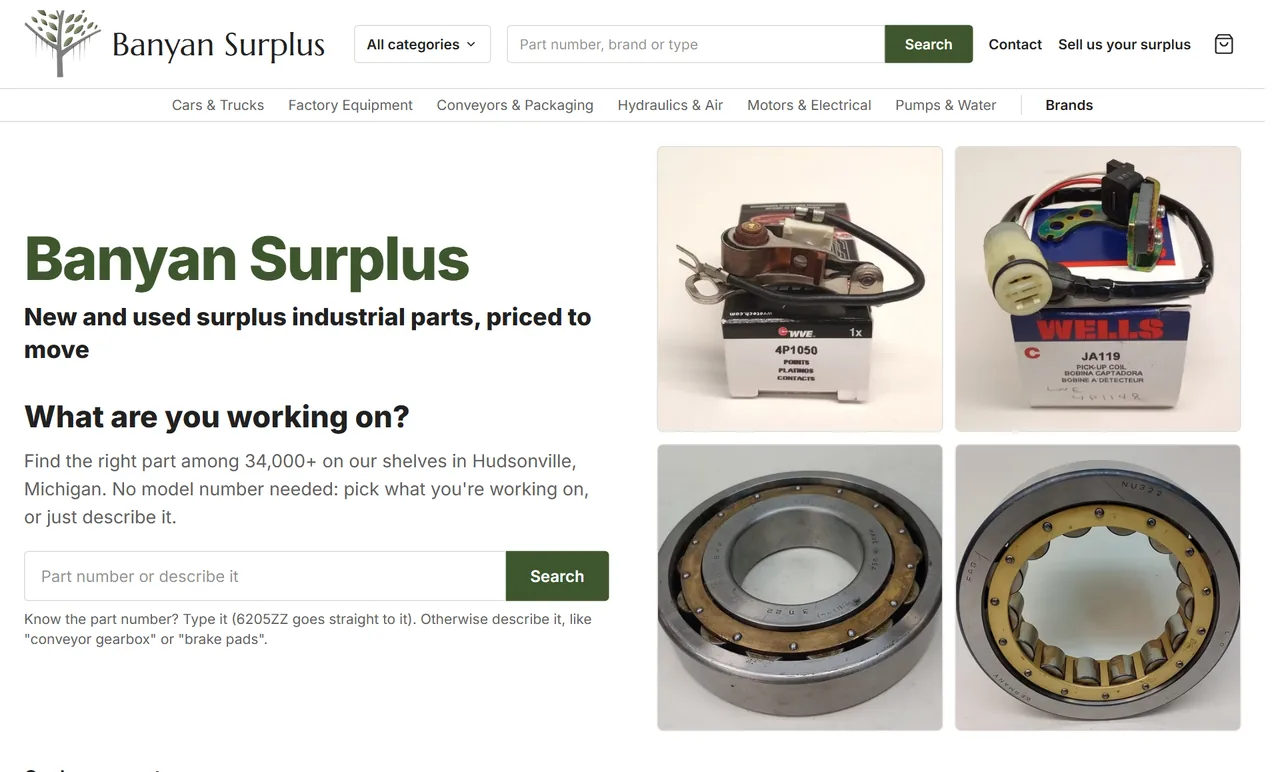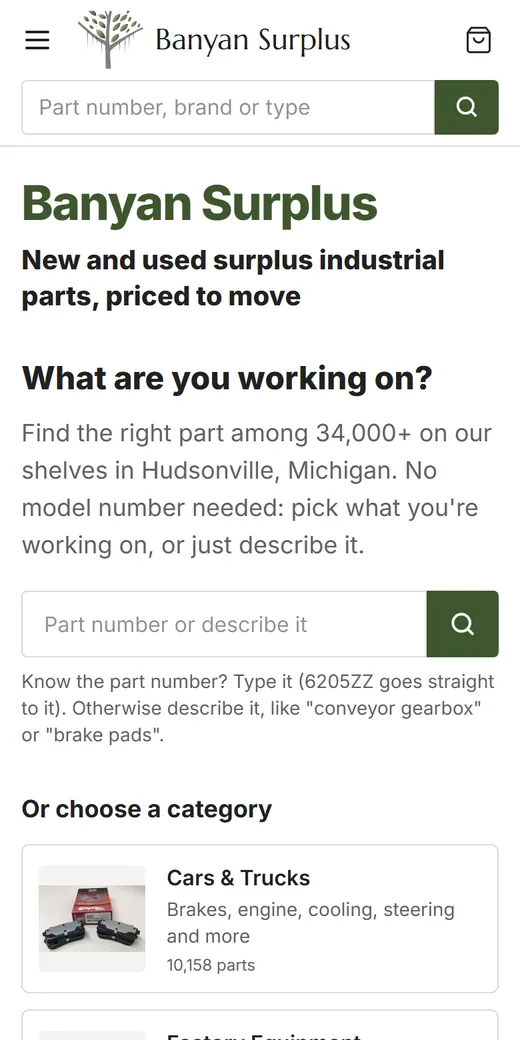
If you sell surplus industrial parts, used auto parts or liquidated stock on eBay, you already have the hard part: thousands of listings with photos, specs and prices. What you do not have is a store of your own. eBay owns the buyer relationship, sets the fees and decides who sees your listings. Your own store, kept in step with eBay, changes that without asking you to list anything twice.
Who this is for
- Surplus industrial dealers with bearings, motors, hydraulics, pneumatics, controls and conveyor parts.
- Used and new-old-stock auto parts sellers whose listings carry vehicle fitment.
- Liquidators and resellers with thousands of one-off items that come and go every week.
The common thread: a big catalog, lots of single-quantity items, part numbers that matter, and buyers who search by part number or by the machine they are fixing.
What we build
A mirror of your eBay store. Every listing becomes a product on your site with every photo, the title, condition and condition note, eBay item specifics, shipping details and price. See eBay and inventory integration for how the sync works.
A daily sync, or more often. New listings appear, changed prices update, ended listings are hidden once eBay confirms they ended, and relisted items come back. The schedule is set by eBay’s API limits and the size of your store; the target is hourly where the limits allow it.
A finder for people who do not know the category name. “What are you working on?” with a handful of plain choices (cars and trucks, factory equipment, conveyors, hydraulics, motors, pumps) gets a buyer to a shortlist in two or three clicks.
Search that understands part numbers. Buyers type part numbers with dashes, without dashes and with spaces. The search treats them as the same and still handles plain descriptions like “brake pads for my truck”.
Categories that follow eBay’s own. You already picked an eBay category for every listing. We build the store’s category tree from eBay’s taxonomy, so every part is filed where you put it, and the detailed tree stays available for search engines and for shoppers who like to browse.
Brand pages. Every major brand gets its own page with its parts and, where we have the right official file, its logo.
Vehicle fitment from real data only. For parts linked to eBay’s parts catalog, the “fits these vehicles” list comes from eBay’s compatibility data. We never generate a “may fit” list, because a wrong fit becomes a return and search engines treat invented lists as keyword stuffing.
A staff order screen. Your workers sign in to the website, see orders, mark them shipped and print packing slips without access to the owner’s account.
Alerts and a daily report. New orders and messages go to email or Discord with every detail, and a daily check confirms the sync ran, counts what changed and flags only real problems. See automations and alerts.
Shipping, payments and policies
Free shipping on eBay does not have to mean free shipping on your site. Many sellers charge real carrier rates on their own store, calculated from the buyer’s address, using a shipping weight for every item (estimated per item from its data, with your real weights winning). Heavy items over a carrier’s limit get a freight option. Returns follow the policy you already use on eBay, and payments are connected in your business’s own name.
The rules to know before you start
eBay’s API License Agreement restricts using eBay content to build a site that competes with eBay without eBay’s written consent, and it expects listing data to be kept fresh. We raise this at the start and plan for it: get eBay’s written OK, or use Wix’s own eBay connection. Our guide to selling on your own website and eBay covers this and the other decisions, like how to stop a one-off item from selling twice.
Getting found
A parts store with tens of thousands of products needs search engines to see all of them. Each product gets its own address, title with brand and part number, and structured data; category and brand pages get introductions; and sitemaps list every product. Once the store is live, a product feed can put your parts in Google’s free shopping listings. Our guide to organizing a large parts catalog explains how the catalog structure supports all of this.
How it starts
We look at your eBay store first: how many listings, which categories, how clean the item specifics are, how many carry vehicle fitment. That tells us most of what the build involves. The cost guide explains which of those factors make a project bigger, and how we work shows the steps from first call to launch.