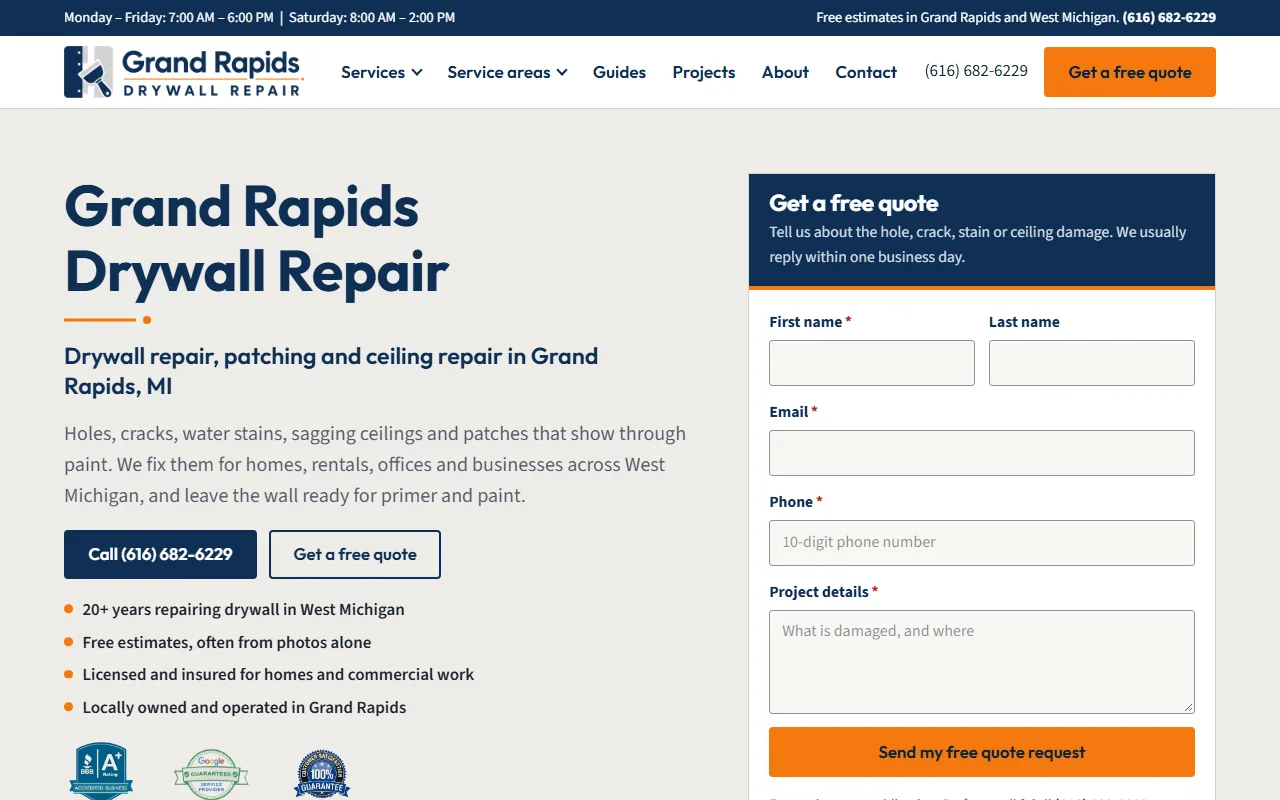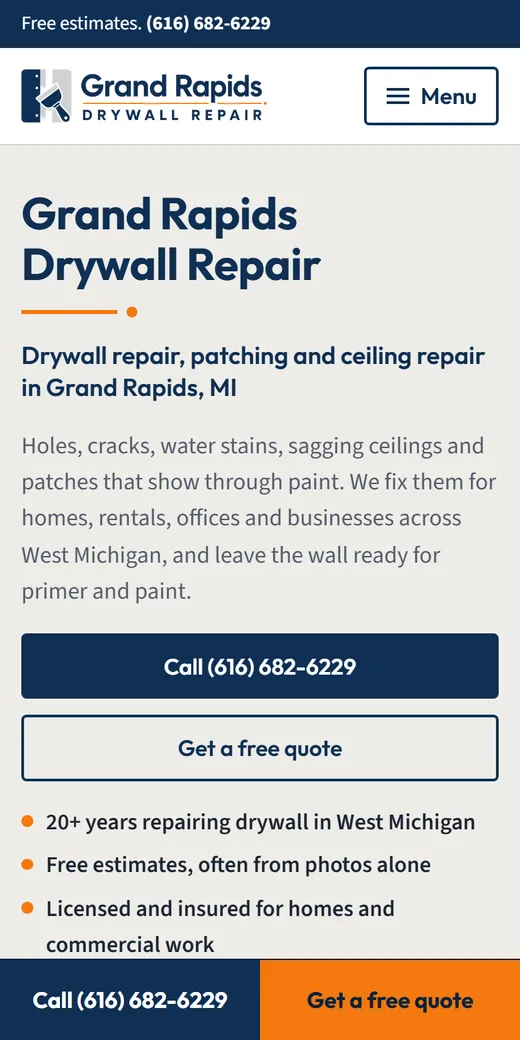
Drywall contractors get two kinds of customers who search in very different ways. A homeowner with a hole from a doorknob, a water stain on the ceiling or a basement to finish searches on their phone, often with a photo of the damage already taken, and wants to know if you take jobs that size and how soon you can come. A builder, remodeler or general contractor looking for a hang-and-finish crew usually hears your name from someone else, then checks your website to see whether you look established, carry insurance and can keep up with their schedule. Many drywall businesses want more of one of these and less of the other. The website should make that choice clear.
Where drywall websites fall short
- No clue what size job you take. A site that never says whether you do small repairs gets calls for single nail pops you will turn down, while the builder with a row of new homes wonders if you are too small.
- Homeowners and builders mixed together. A repair customer does not care about board counts and schedules, and a builder does not want to read about patching a doorknob hole. One page for both serves neither.
- Photos with no story. Finished drywall is a flat white wall. Without a before shot and a caption, a gallery cannot show the skill involved.
- Texture and finish work hidden. Knockdown and orange peel matching, skim coating, popcorn ceiling removal and Level 5 finishes are searched for on their own, and many sites never mention them.
- Forms that skip the basics. If the form does not ask wall or ceiling, the room, the size of the damage and whether there was a leak, every request becomes a phone call before you can quote.
- Nothing for water damage jobs. People repairing after a leak or a burst pipe may be working with an insurance adjuster and want to know you handle that kind of job and can write up the scope clearly.
What we build for drywall contractors
- A page for each service you want more of: drywall repair, water damage repair, texture matching, popcorn ceiling removal, skim coating, basement finishing, and new construction hang and finish. Each says what is included and what drives the cost.
- A builder and contractor page with the work you take on, how you schedule, your insurance, and how to send plans for a bid. Builders read this before they call.
- Repair forms with the right questions: wall or ceiling, which room, rough size of the damage, texture type if they know it, and whether the leak is fixed. We test each form by sending a real message that must arrive in your inbox.
- Alerts by email or Discord on new requests, so a repair lead does not wait until you are off the jobsite. Our website automations page has the details.
- Before-and-after photos with captions that explain the work: cut out, replaced, taped, textured to match. We resize them so pages stay fast.
- Plain explanations of finish levels and textures, so homeowners comparing quotes understand why a Level 5 finish under a bright window takes more work than a Level 4 in a closet.
- Honest safety notes, like testing older textured ceilings for asbestos before removal, written in plain words.
- Licenses, insurance and years in business shown only when they are real and current.
- Tap-to-call on phones, and every page checked at nine screen sizes.
Getting found for drywall work
Homeowners type the problem: “drywall repair near me”, “fix water damaged ceiling”, “popcorn ceiling removal”, “knockdown texture repair” or “basement drywall contractor”. Each of those deserves its own page, written about that job. Builders search less and check more, so the builder page needs to read well when someone lands on it from a referral.
The Google Business Profile is how many homeowners find a drywall contractor in the map results. We prepare it with the drywall contractor category and others that fit, your services, the area you cover, photos and the website link, and you sign in and verify, since Google requires the owner to do that. Reviews appear on your site as the real rating with a link to the source, never copied.
Service area pages go up only for towns you really work in, each with content true for that town, such as the older homes with plaster walls or the new subdivisions you hang in. AI assistants are another way people find a contractor now, and they rely on sites that say plainly what the business does and where. Our SEO and AI visibility work covers Google, Bing and those assistants, with structured data describing your services. No one can guarantee a ranking, and we do not promise one.
What we need from you
- The services you offer, and whether you want more homeowner repairs, more builder work or both.
- Any minimum job size or work you turn down.
- The towns you cover.
- Before-and-after photos, with a sentence on what each job involved.
- Insurance, licenses and years in business.
- For builder work: the kinds of projects you take and how you want bid requests to arrive.
We send a written proposal that lists one-time and monthly costs separately. After launch, managed hosting keeps the site up with a daily check that only alerts on real problems. The contractor website checklist and our page on websites for contractors cover the rest. Read what drives the cost or send us a few details to get started.